


Key takeaways
Custody is the first decision, not the last. Who can move the coins matters more than which coin you bought.
Volatility is the feature and the risk. Position size is the only real defense, and it is the thing most people set by feel.
The IRS treats crypto as property, so nearly every swap, sale or purchase with crypto is a taxable event you have to record.
Counterparty risk is separate from market risk. An exchange balance is a claim on a company, not the asset itself.
Records are the boring thing that decides how painful April is. Start them on day one, because reconstructing them later is expensive.
Before you take a position that actually matters to you, there are a handful of things worth understanding. Not opinions about which asset wins. The mechanics that decide whether the position survives contact with real life.
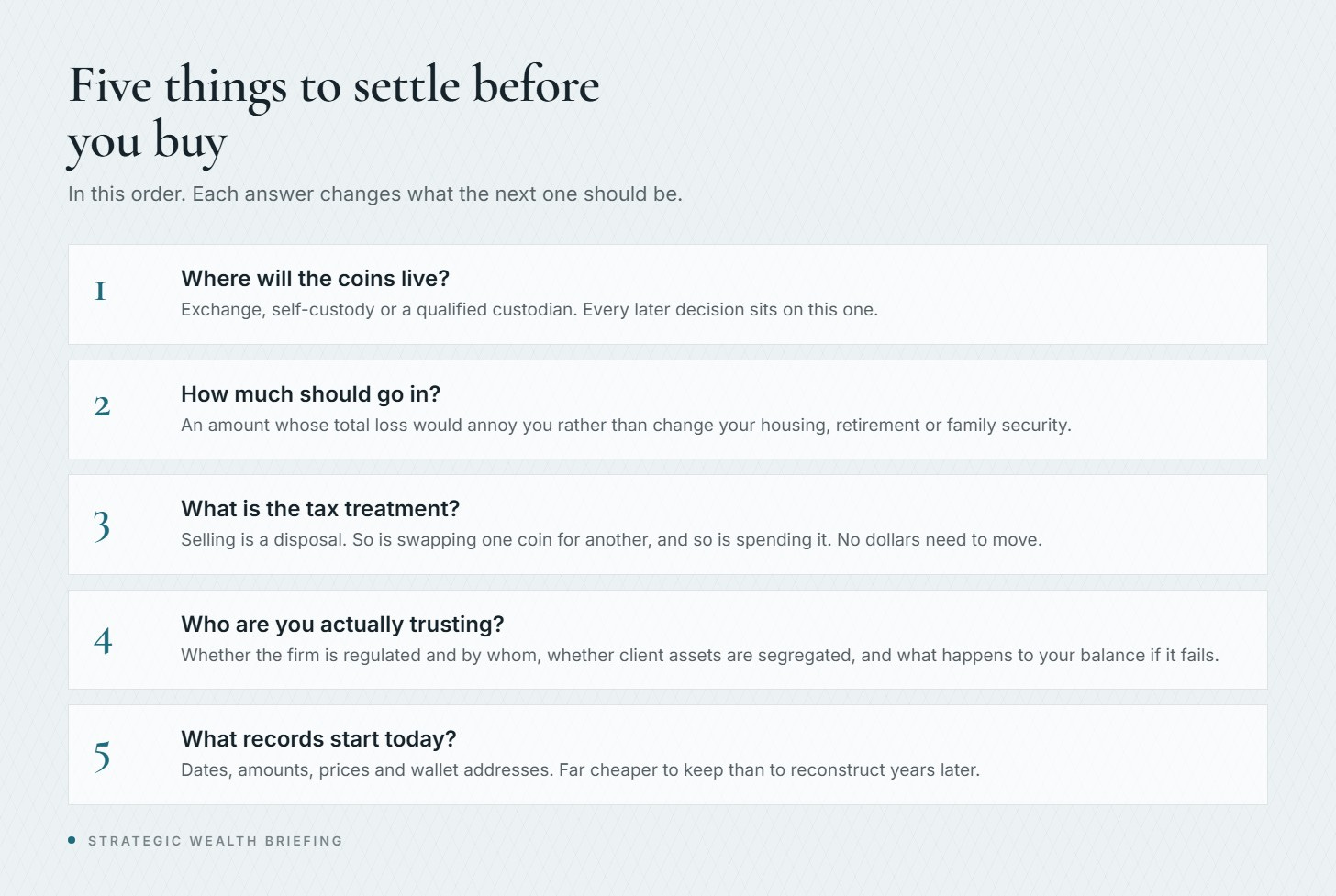
Five questions to answer before your first crypto purchase. The tax and counterparty answers are the two people skip.
Where will the coins actually live?
Start here, because it is the decision everything else sits on.
Buying on an exchange and leaving the balance there is the default, and it is not custody. You hold a claim against a company. That claim behaves very differently from the asset when the company has a bad quarter, and the last several years supplied more examples of that than anyone wanted.
Your real options are self-custody with your own keys, a regulated custodian holding the assets under a defined standard, or a split-key arrangement where no single party can move funds alone. For a small first position, a hardware wallet is a reasonable answer. As the balance grows, single-key custody puts an uncomfortable amount of risk on one person having one bad day.
Decide this before you buy, not after.
How much should you actually put in?
The honest answer is an amount whose total loss would annoy you rather than change your life.
That sounds glib, but it is the only rule that survives a real drawdown. Assets in this category have repeatedly fallen 70% or more from a high and taken years to recover. Any position sized on the assumption that will not happen again is sized on hope.
Two practical framings:
If it went to zero tomorrow, would this change your housing, your retirement, or your family's security? If yes, it is too large.
If it fell 70% and stayed there for two years, would you still be able to hold? If no, you will sell at the bottom, which is the worst outcome of all.
Volatility is not a bug you can engineer away. It is the price of the upside, and position size is the only lever you fully control.
What does the tax treatment actually mean?
This is where people get caught, because the rule is not intuitive.
The IRS treats digital assets as property, not currency. That has three consequences worth memorizing:
Selling for cash is a disposal, and gain or loss is measured against your basis in those specific units.
Swapping one coin for another is also a disposal, even though no dollars moved. This one surprises almost everyone.
Spending crypto is a disposal too. Buying something with a coin means disposing of it at that day's value.
What is not a disposal: buying with cash, and moving coins between wallets you own. The second one still matters for records, because your basis travels with the units.
Basis is now tracked per wallet and per account rather than pooled across everything you hold. So which platform you sell on changes the tax. Set your records up that way from the start.
Who are you actually trusting?
Market risk gets all the attention. Counterparty risk does more damage.
Every platform you touch is a company with a balance sheet, a management team, and incentives you cannot see. Before you leave meaningful value anywhere, ask:
Is the company regulated, and by whom, and for what specifically?
Are client assets segregated, or pooled with the firm's own?
What happens to your balance if the company fails?
What are the withdrawal controls, and what stops a convincing impersonation of you?
If a platform is offering a yield, the useful question is where the yield comes from. Someone is paying it, and understanding what they are doing with your asset meanwhile is the entire diligence.
What records should you keep from day one?
More than you think, and it is far cheaper to keep them than to rebuild them.
For every acquisition: date, quantity, price, fees, and which account it landed in. For every disposal: the same, plus which units you sold. For every transfer between your own wallets: label it clearly as a self-transfer so it never gets mistaken for a sale.
Export statements while platforms still exist. Exchanges close, get acquired, and lose history. An export today costs you five minutes. Reconstructing three years of activity from bank records and block explorers costs real money and a professional's time.
A quick FAQ
Is crypto a good investment? That is not a question anyone should answer for you in a post. What is answerable is how to hold it, size it, and record it so a bad outcome stays survivable.
Do I owe tax if I never cashed out to dollars? Often yes. Swapping one coin for another is a disposal even though no cash was involved.
Is a hardware wallet enough? For a modest position, usually. As the balance grows, splitting keys or adding a custodian removes the single point of failure.
What is the most common way people lose money here? Not a hack of the blockchain. Losing access, being persuaded to hand it over, or being forced to sell at a low because the position was too large to hold.
The short version
Decide where the coins live, size the position so a 70% drop is survivable, understand that swaps and spends are taxable, know who you are trusting, and keep records from day one.
None of that tells you what to buy. All of it decides whether the thing you buy is still yours in five years.